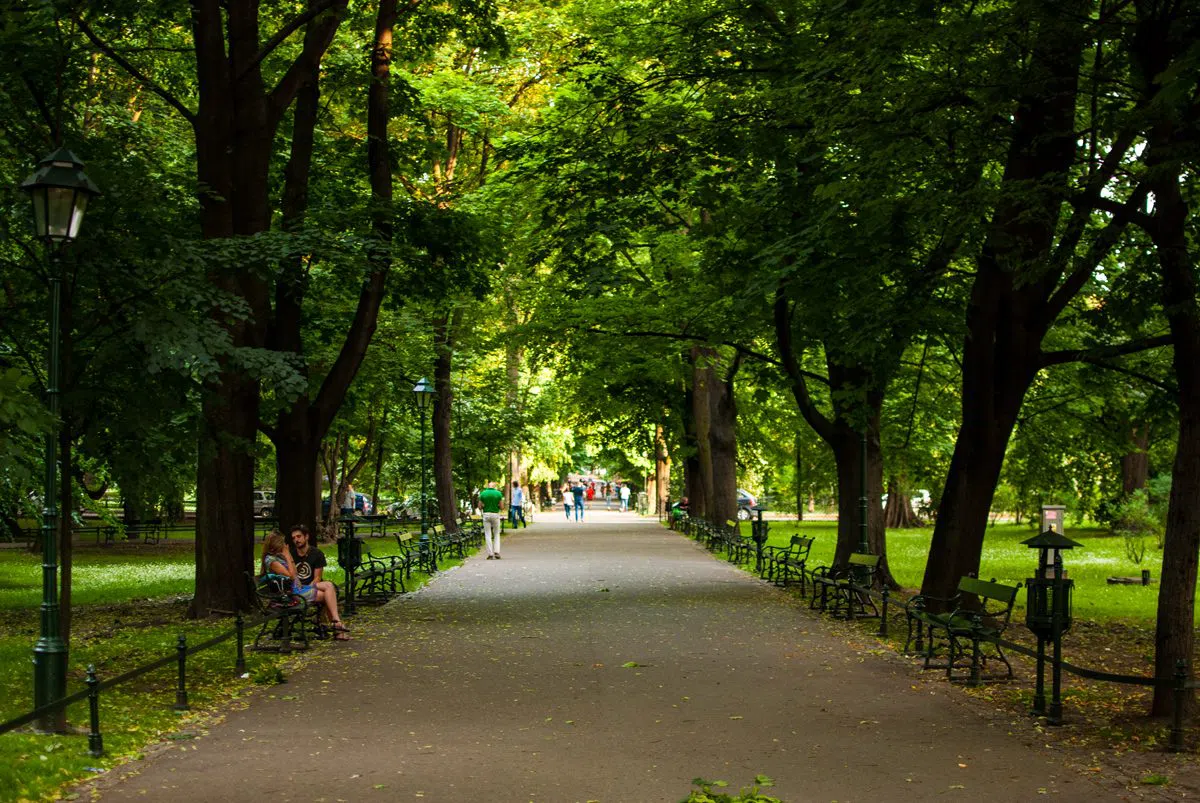

Kraków's Old Town is ringed by a park that used to be a wall, and for about ninety minutes each morning it is nearly empty. Before the horse carriages line up on the Rynek and the guided groups start pooling at the Barbican, the ring is just joggers, pigeons, and a scattering of early Masses lit up behind stained glass. This is the version of the walk worth doing.
The Ring Kraków Built From Its Walls
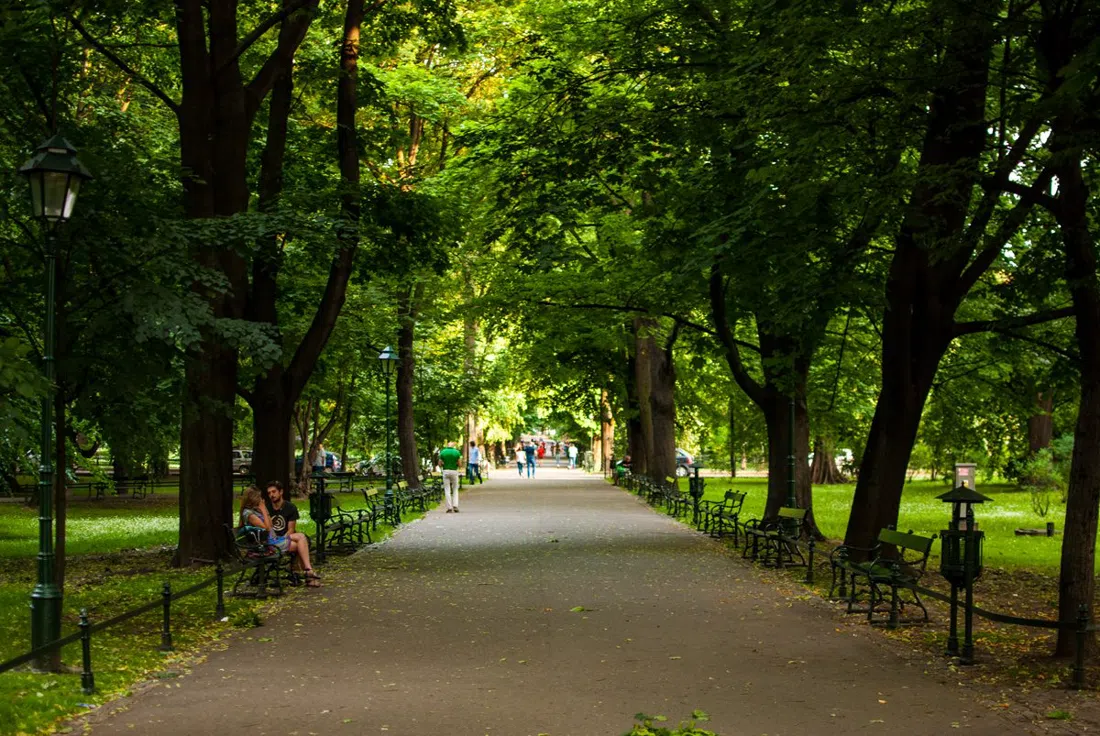
Planty Park (the Garden Ring, encircling the Old Town) is the reason this route exists at all: a continuous belt of lime trees, benches, and gravel paths laid out in the 1820s directly on top of the medieval fortifications that used to encircle Kraków, after the city fathers decided a green promenade was more useful than a crumbling wall. It is unticketed, unfenced, and open around the clock, which makes it the one stop on this walk with no door policy to navigate at all — a group of two or twenty can move through it shoulder to shoulder without anyone checking anything. The full loop is a little over four kilometres if you keep to the path proper, longer with the detours below. At sunrise in high summer that means starting around 4:45am; in shoulder season, closer to 6am. Nobody official times it, so give yourself a genuine two unhurried hours rather than racing the light — the whole appeal of doing this at dawn is that nothing about it should feel rushed.
A Detour to the Florianka
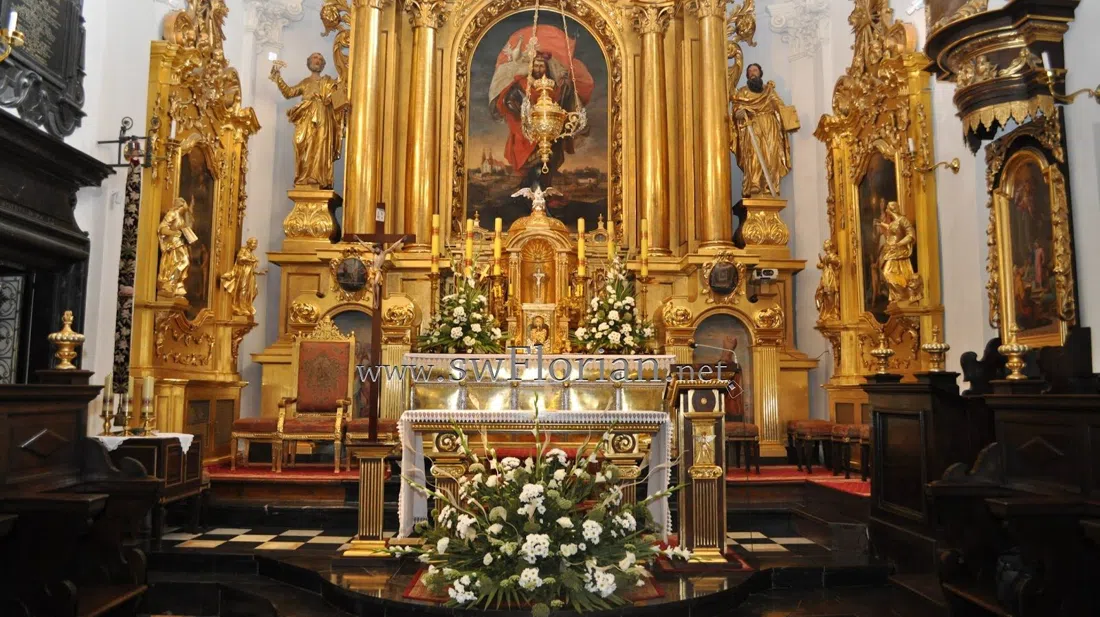
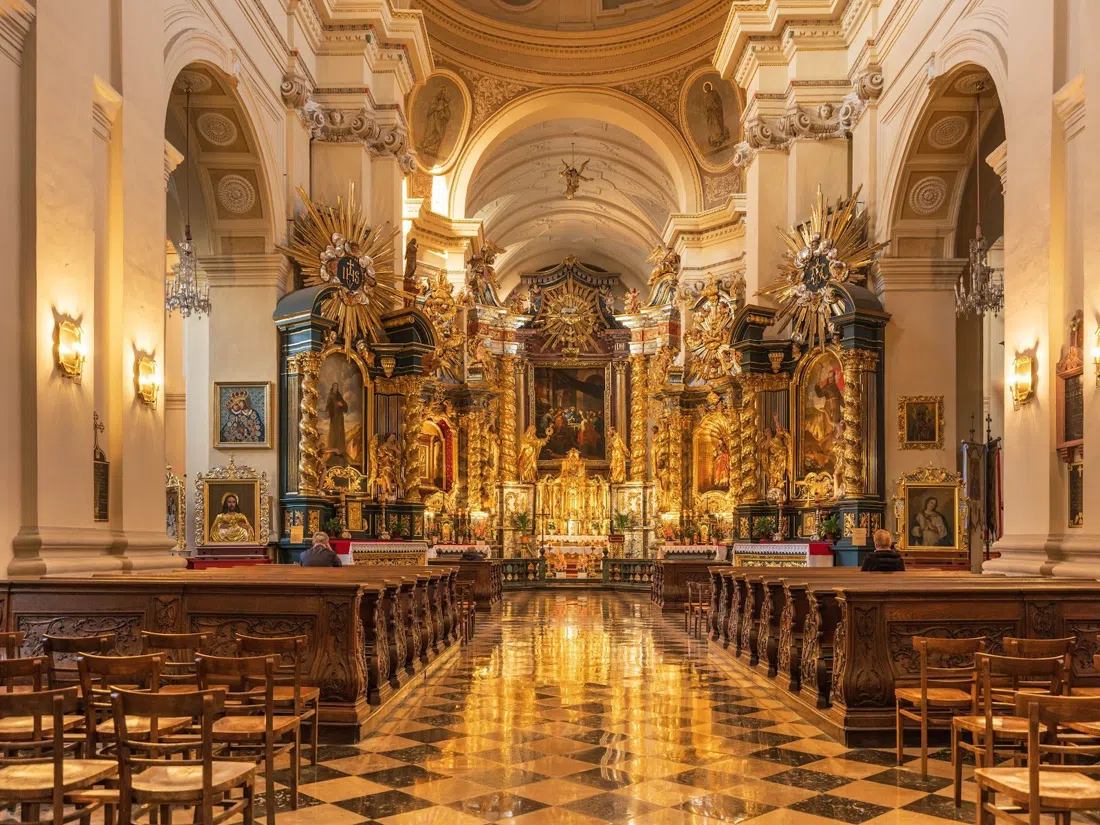
The purest reason to be up this early sits just north of the ring, on ul. Warszawska in Kleparz, the old market district that grew up outside the medieval walls. Bazylika św. Floriana — everyone in Kraków calls it the Florianka — opens its doors at 6am daily, with Masses running through the morning, which makes it one of the only named stops on this walk that is genuinely, not just photogenically, open before breakfast. It's a working parish church rather than a museum piece: small groups are welcome to sit quietly at the back during a service, but this isn't the moment for a guided tour with a raised umbrella and a headset system — save that for later in the day. The historical hook here is specific rather than decorative: a young Karol Wojtyła served here as vicar between 1949 and 1951, years before Kraków's archbishop became Pope John Paul II, and the basilica has quietly built part of its identity around that fact ever since. Walk back south toward the ring the way you came; the detour adds roughly fifteen minutes each way.
Plac Matejki and the Return to the Ring
Where the Florianka's street meets the Planty proper, the ring opens into Plac Matejki and the Grunwald Monument, an open public square with no restriction on group size and nothing to buy a ticket for. The monument marks the 1410 Battle of Grunwald, in which combined Polish-Lithuanian forces broke the Teutonic Knights in one of medieval Europe's largest field battles — a result still taught in Polish schools with the kind of weight other countries reserve for a handful of dates a century. It's also useful route logic: this is exactly where the Florianka detour rejoins the ring, so if you skip the church you simply arrive here first and lose nothing.
Where the Old Route Began
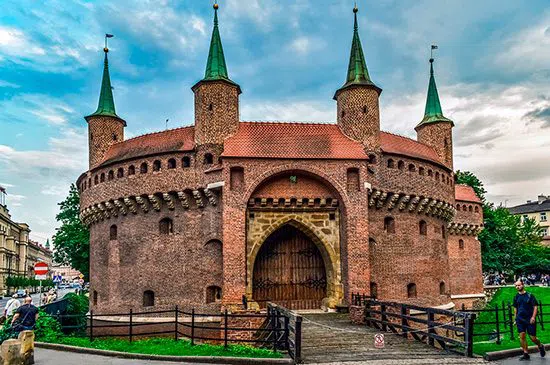
From Plac Matejki, the ring's north edge holds two stops close enough together to visit as one. The Barbakan (Kraków Barbican) is one of only a handful of circular barbicans still standing anywhere in Europe, and its exterior and grounds are viewable by a group of any size at any hour; the paid interior, run as part of the Museum of Krakow, doesn't open until 10:30am (April–October, closed every second Monday), so at sunrise you're simply looking at the thing itself, brick and moat and all, without a single tour flag in the frame — a view that's mathematically impossible by 11am once the day's groups arrive. Immediately south of it, St Florian's Gate and the attached Defence Walls (the Joiners', Haberdashers' and Carpenters' Towers) mark the start of the old Royal Route: every Polish coronation procession once passed under this exact arch on its way to Wawel. The gate passage itself is a functioning street and never closes; the wall-walk exhibition inside opens later, around 9am in summer, with a small separate fee for groups who want it. At sunrise, it's just you and the street cleaners.
Two Buildings Meant to Be Empty
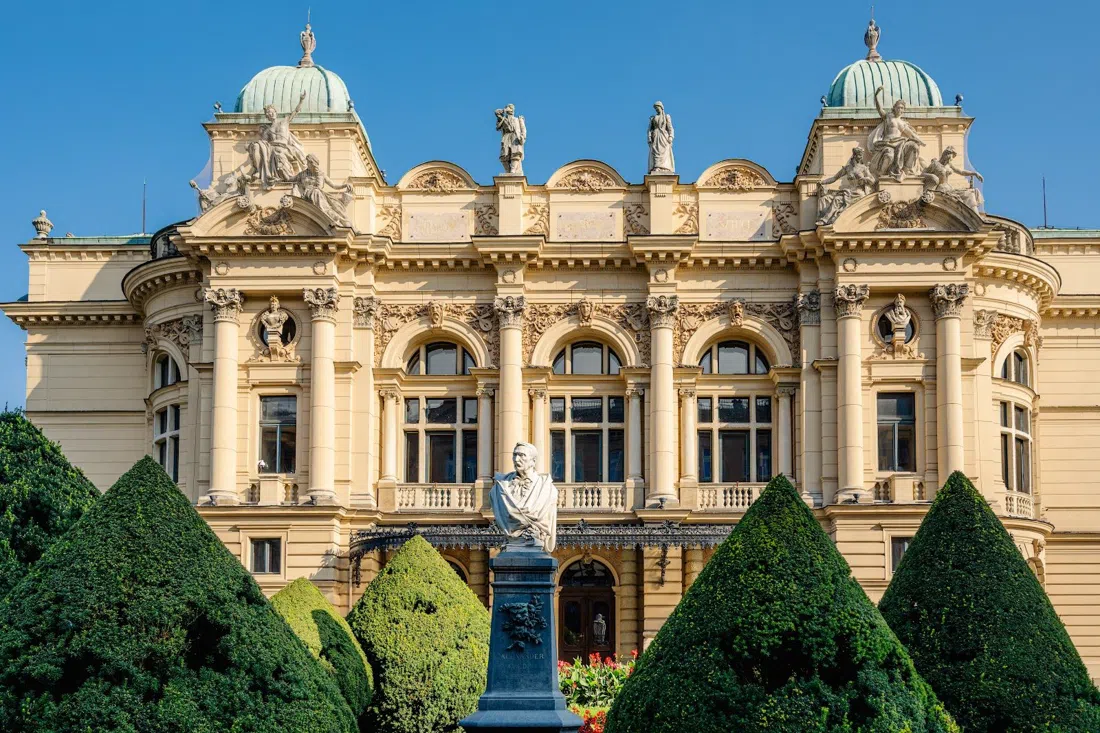
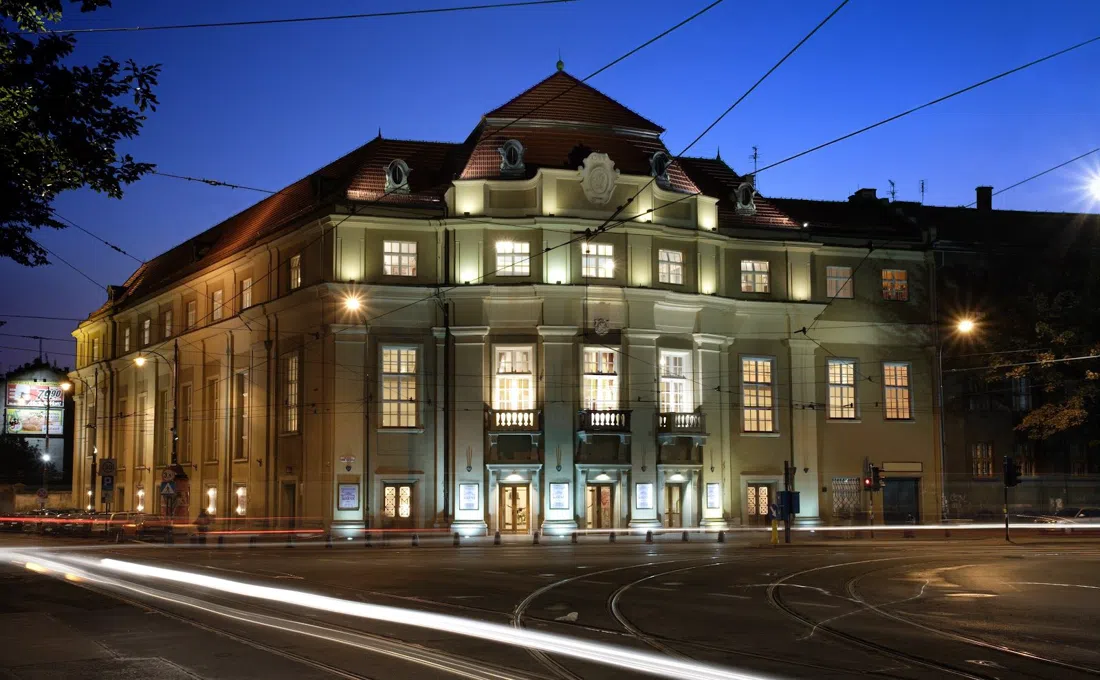
The ring's western stretch holds two stops that work purely as architecture at this hour, since neither opens for business until well after sunrise. The Filharmonia im. Karola Szymanowskiego (Kraków Philharmonic) is an unexpected beat on this part of the walk — its exterior is unrestricted for a group of any size, and its box office won't open for hours, but the building itself is worth the pause: it's home to Poland's first professional orchestra formed after the Second World War, and at sunrise the hall is dark and properly silent, which a concert hall almost never is. A short stretch further along, the Teatr im. Juliusza Słowackiego does the same job on a grander scale — its square is unrestricted for groups, its box office opens at 10am on weekdays, and the building itself is part of Kraków's UNESCO-listed Old Town. It is, by a wide margin, the most theatrical building the ring passes, and the only time to see its square with genuinely nobody else on it is now, not at noon.
The University's Empty Courtyard
On the ring's southwest edge, the Collegium Maius courtyard belongs to the Jagiellonian University and is free to enter for a group of any size — the museum's guided interior tour is a separate, paid, pre-booked English-language walk that only runs at 1pm, so there's no crossover to worry about. What you're standing in is Europe's oldest university courtyard still in use, arcaded and quiet. The trick here is arriving right as it opens rather than at sunrise itself: aim for 9am sharp and you'll have the arcades to yourself before the day's first tour group has even assembled outside.
South to Wawel
The ring bends south past Bazylika oo. Bernardynów (St Bernardine's Basilica), a working parish church that sits at the quiet hinge between the Planty and Wawel — small groups are fine outside Mass times, and Sunday services start at 7am, but on an ordinary weekday morning it's usually just the resident monks and a scattering of pigeons. From here the ring delivers its intended finale: the Wawel Royal Castle grounds and ramparts, free and open from 6am to dusk with no restriction on group size, though the ticketed interiors — the State Rooms, the Cathedral — don't open until roughly 9:30 or 10am. Walking up while the ticket booths are still shuttered is the whole point of doing this route at dawn rather than at noon: the courtyards are empty of every tour flag in the city, which is not a claim you can make about Wawel at any other hour of any day.
The River and the Dragon
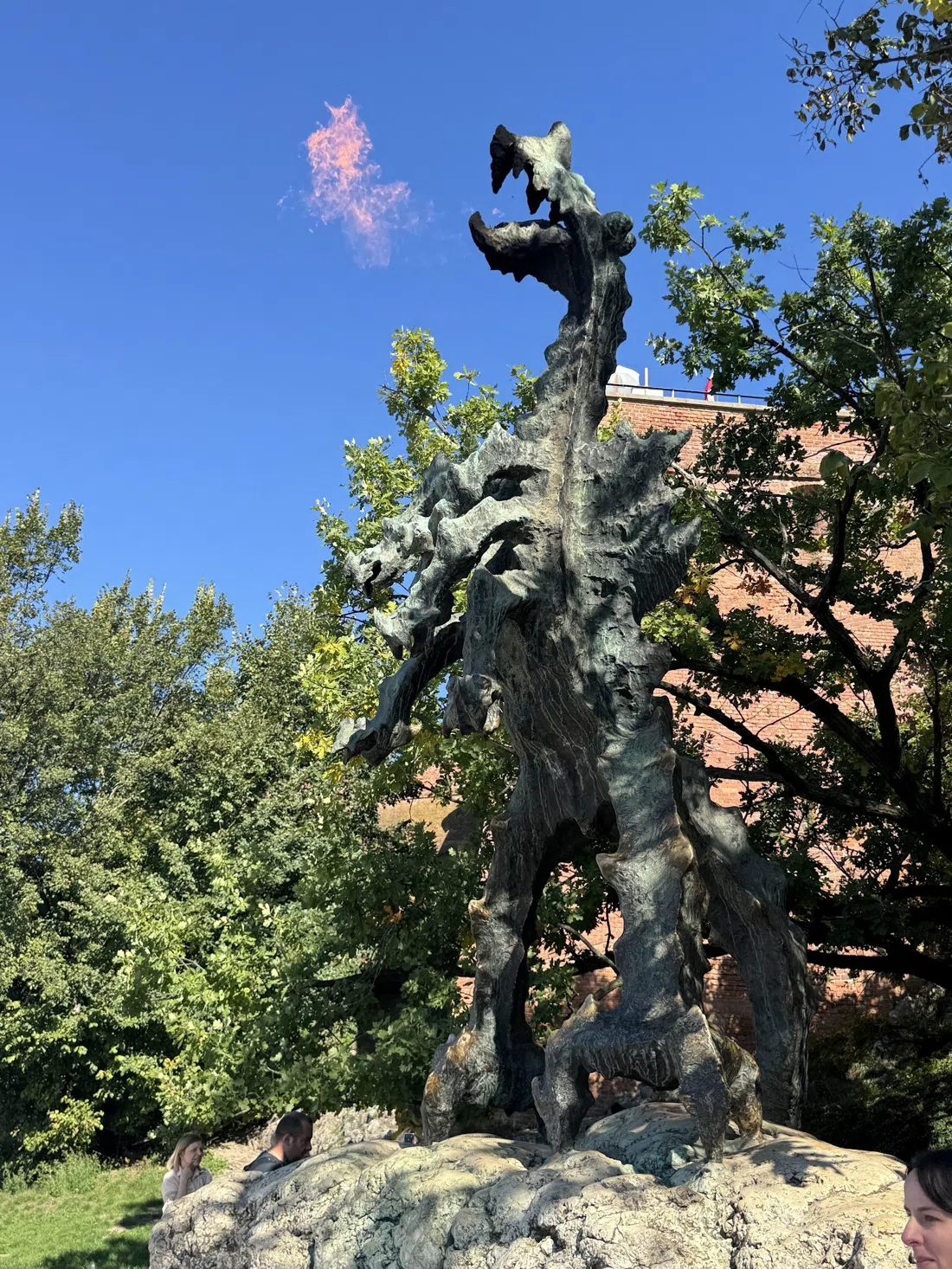
Down from the castle, the ring's loop closes at the water. The Smok Wawelski (Wawel Dragon) statue and the Vistula Boulevards form an open riverside public space, unrestricted for groups of any size and free to walk. The boulevards themselves are wide and mostly benches at this hour, still cool from the night, with rowers occasionally out on the water before the joggers arrive in force. The statue breathes real fire roughly every ten minutes, and it doesn't start drawing a crowd until later in the morning — sunrise is the one window in which you can actually see it without a semicircle of phones held up in front of it.
One Worth Coming Back For
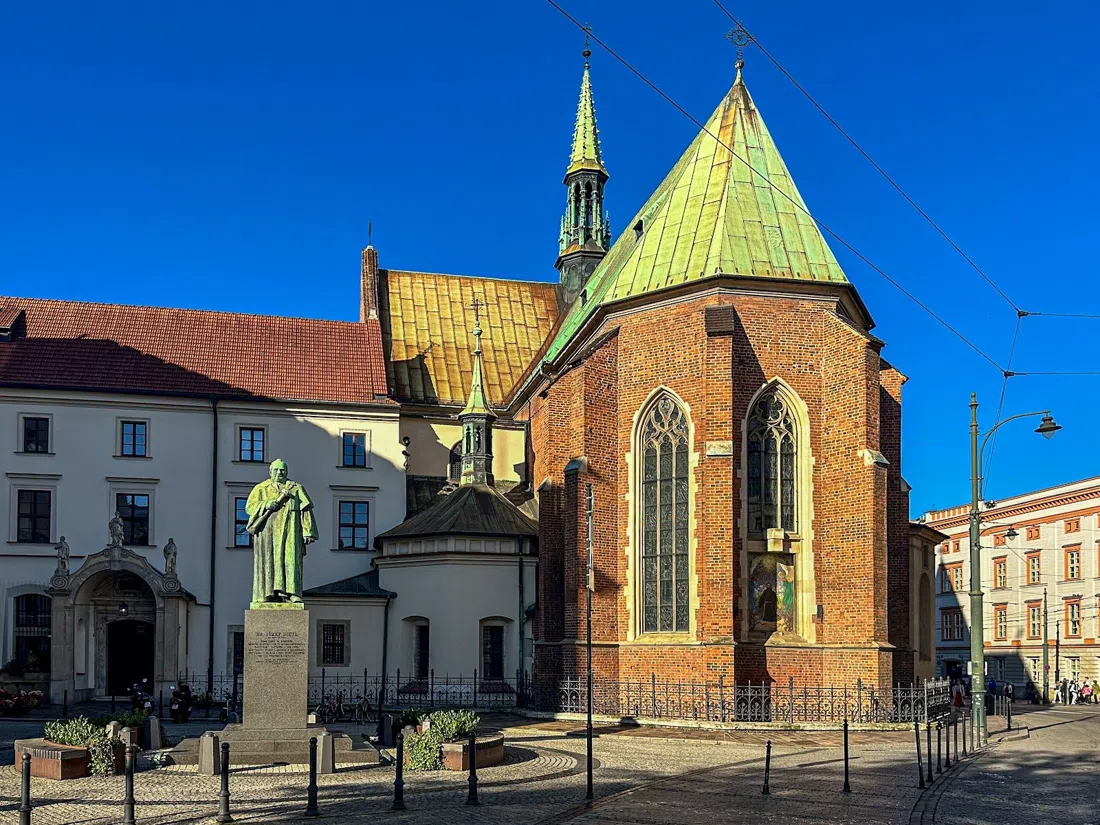
Not everything on the ring works at this hour, and it's worth saying so plainly. The Bazylika św. Franciszka z Asyżu (Basilica of St Francis of Assisi), a short walk from both Wawel and the Collegium Maius, is exterior-only at sunrise. The nave doesn't open until 10am on weekdays (1–4pm on Sundays), so Stanisław Wyspiański's famous stained-glass window inside — Becoming, one of the more startling pieces of Art Nouveau religious art anywhere in Poland — has to wait for a second visit later in the day. Note the façade now, and come back after breakfast.
Breakfast on Plac Szczepański
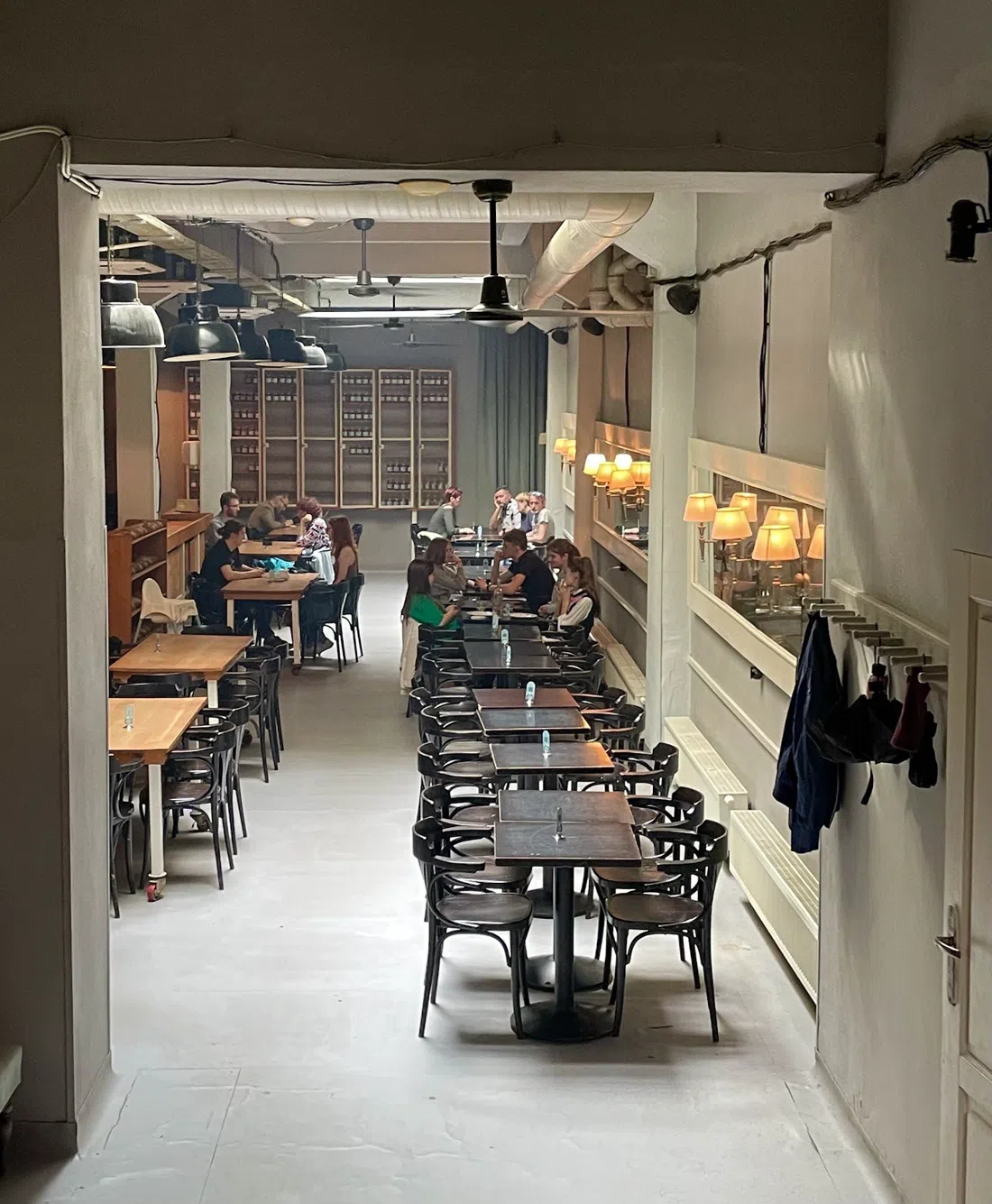
Loop back north along the ring's inner edge to Charlotte — Chleb i Wino, on Plac Szczepański, which is the one genuinely open-at-7am breakfast stop directly on the route. Seating is first-come for small-to-medium groups with no formal door policy, though larger parties are better off calling ahead. Coffee and a pastry run roughly €3–6; a full bistro breakfast, €12–20. After two hours of empty streets, it's the obvious place to sit outside, order a croissant, and watch the Old Town wake up around you — tour buses and all.
The Practical Bit
Getting there. Most of this route sits within a fifteen-minute walk of the Rynek Główny, so there's little reason to take transport at all; if you're staying further out, Kraków's night trams run until around 3:30am and the day network restarts by 5am, covering the ring's edges at Plac Matejki and near Wawel.
Cash. Every stop on this walk is free at sunrise — Planty, the Florianka, the Grunwald Monument, the Barbican's and gate's exteriors, both theatres' exteriors, the Collegium Maius courtyard, both southern basilicas, and the Wawel grounds. The only spending happens later, at Charlotte, or if you come back for a ticketed interior (the Barbican and Defence Walls, Wawel's State Rooms, the Collegium Maius guided tour). Cards are accepted everywhere in central Kraków; carry a little cash anyway for the smaller church donation boxes.
Timing. Sunrise in Kraków runs from roughly 4:30am in June to nearer 7am in December, so check the date before setting an alarm — this is a different walk in high summer than it is in November. Give the full loop, with the Florianka detour, about two unhurried hours.
Budget. Free, unless you stop for coffee. If you plan to come back later for any of the ticketed interiors, budget roughly 30–60 zł per person across the day.
Book ahead for the season with a Krakow hotel search, and for the rest of the city's set pieces once the tour groups are up, the full Krakow guide covers what to do after this walk ends.